
Last Thursday, I read in ‘The Hindu’ that the Reserve Bank of India (RBI) has made it mandatory for all banks to transform all the ATM machines to be disabled-friendly. The news article talks about installation of talking ATMs with Braille keypads, construction of ramps to ATMs and bank branches, etc. The article left me wondering how do I ensure that the content I write is suited for differently-abled people.
While there is a industry-standard guideline for content accessibility, it may be quite exhaustive for a beginner. Additionally, in a corporate world, it is necessary that all stakeholders (apart from authors) in a web content project understand and acknowledge the importance of accessibility.
The following simple practices will enable your web content to become more differently-abled friendly:
- Write meaningful heading or titles for each page.
- Write meaningful text for link references. Additionally, ensure that the link opens in a separate window if it is an external link. Provide a meaningful description for the link, if possible, as in the following screenshot:
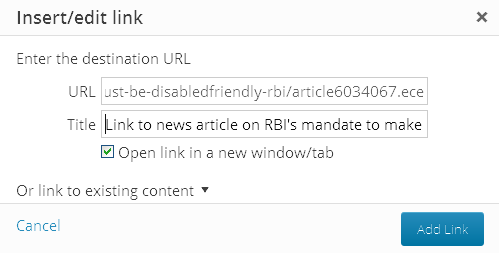
Provide meaningful link titles
- Provide alternative text for images so that people who cannot see can understand what the image is conveying. Provide a caption and description for the images, if possible. Of course, you need not provide alternative text for decorative images.
- Tag headings, titles, tables with appropriate HTML tags with the help of a developer.
While the above practices are the not the only guidelines for accessibility, these are definitely good to begin with. I request you to share your tips in the Comments.
 Ravi Writes